FARHD Factory Visit: What to Know Before Visiting Our Shenzhen Factory
Novembro 23, 2026
Partilhar este artigo
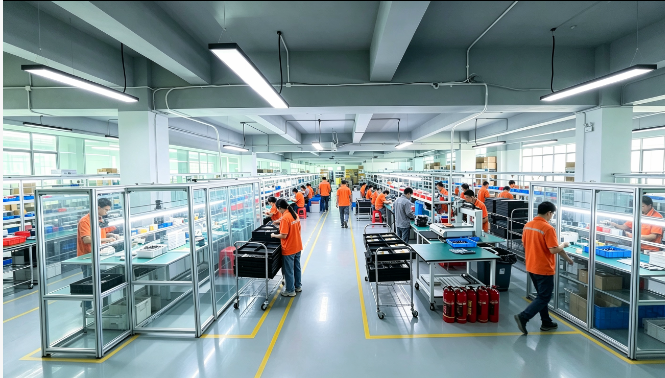
A supplier’s website can show you products. A video call can show you a showroom. But neither can show you what happens between a component arriving at the loading dock and a finished intercom system being packed for shipment. That gap—the production floor—is where quality is actually decided, and it is precisely what a factory visit exists to close.
FARHD has manufactured video door phones and intercom systems in Shenzhen since 1998. For more than 28 years, we have hosted distributors, system integrators, real estate developers, and assembly partners from around the world—some arriving to evaluate a first order, others returning to review new products or discuss project specifications in detail. This article explains what a FARHD factory visit involves, how to arrange one, and what you can realistically accomplish in a day.
Why Visit a Factory at All?
Most sourcing decisions today can be made remotely. Samples can be shipped, specifications can be exchanged by email, and video calls can replace many meetings. So why travel in person?
The honest answer is that a factory visit accomplishes three things that remote evaluation cannot:
Verify claims. “We produce core components in-house” is a claim. Walking past the SMT lines, the TFT LCD assembly area, and the camera module calibration stations is verification. The difference matters when you are placing an order for 500 units and need to know whether the supplier controls its own quality or relays someone else’s.
Test products in context. A sample on your desk is useful. But a sample you can compare side by side with other models, test with the cards your market uses, and operate together with the management center that will actually run it—that is a different level of confidence.
Build relationships with the people who will support you. After a project goes live, the person who answers your technical questions matters as much as the product specification. Meeting the support team in person changes the nature of that relationship.
For partners placing meaningful orders, a visit is not a courtesy. It is due diligence.
Arranging a Visit
When to Visit
The most productive time to visit depends on where you are in the evaluation process.
Before a first order, to verify manufacturing capability and test the products under consideration. This is the classic evaluation visit.
Before a large or customized order, to discuss OEM/ODM scope with the engineering team and confirm whether the customization is realistic within your timeline.
During a project’s specification phase, to test the exact configuration before the specification is locked—multi-entrance villa layouts, per-apartment second doorbells, guard station arrangements, and so on.
After a first delivery, to review what went well, discuss adjustments, and plan the next order. Many of our repeat partners visit on a regular cycle.
How to Arrange It
Factory visits are arranged directly with our sales team, ideally two to three weeks in advance, so that samples, test setups, and the relevant engineering staff can be prepared. Contact details are at the end of this article.
When you contact us, the following information will make the visit more productive:
Your business type—distributor, integrator, developer, or assembly partner
The products or categories you want to see—IP systems, 2-wire systems, villa outdoor units, apartment outdoor stations, audio intercom, and so on
The projects you are working on—building type, unit count, number of entry points, and timeline
Any customization requirements—interface language, functional configuration, packaging, branding
The certification documentation you need to review—CE, FCC, RoHS, IP65, or EMC records for specific models
Your travel dates and any scheduling constraints
This information allows us to prepare the right samples, arrange the right people, and structure the day around your priorities rather than a generic tour script.
What a Visit Day Looks Like
Every visit is tailored, but a full-day visit typically follows a structure like this.
Morning: Production Tour
The tour follows the product from component to finished system, because that chain is the point.
Circuit board production. SMT lines. The electronic reliability of an intercom system is decided here, and this is usually where visitors first understand the difference between a source factory and an assembler.
Core component production. TFT LCD screen assembly and testing, camera module production with lens and sensor alignment, and driver board configuration. Relatively few video intercom suppliers maintain these capabilities in-house—this is often the moment during a visit when a partner’s understanding of “source factory” becomes concrete.
Final assembly. How boards, displays, camera modules, and housings come together, including ESD control, torque-controlled fastening, and gasket installation on outdoor units—the step that determines whether the IP65 rating holds in service.
Testing stations. Functional testing, environmental testing, and water resistance verification for outdoor models.
The 24-hour aging room. Every unit runs under power for a full day before shipment. Visitors often want to see this specifically, because it is a claim that is easy to make and easy to verify—either the racks of units running under power exist, or they do not.
Quality control points. Incoming component inspection, in-process inspection, and outgoing verification. For visitors, the point is not that inspection exists, but that it happens at multiple stages rather than only at the end.
Midday: Product Demonstration and Hands-On Testing
After the tour, the focus shifts to products—and this is where the visit earns its value.
The full product range. IP intercom systems for villas and apartments, 2-wire IP systems, 4-wire CVBS and AHD systems, analog apartment systems, wireless video doorbells, audio intercom systems, and various kits.
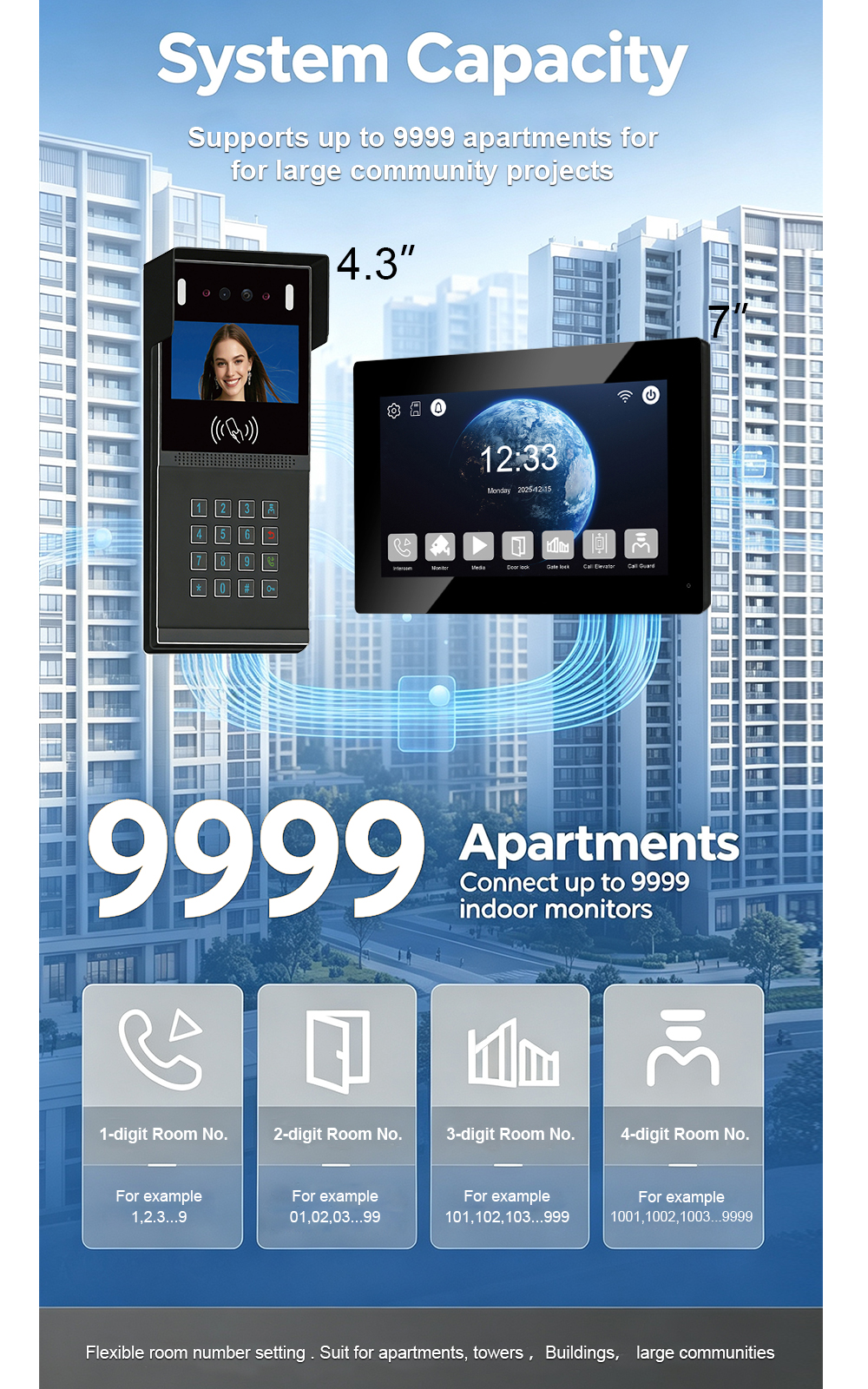
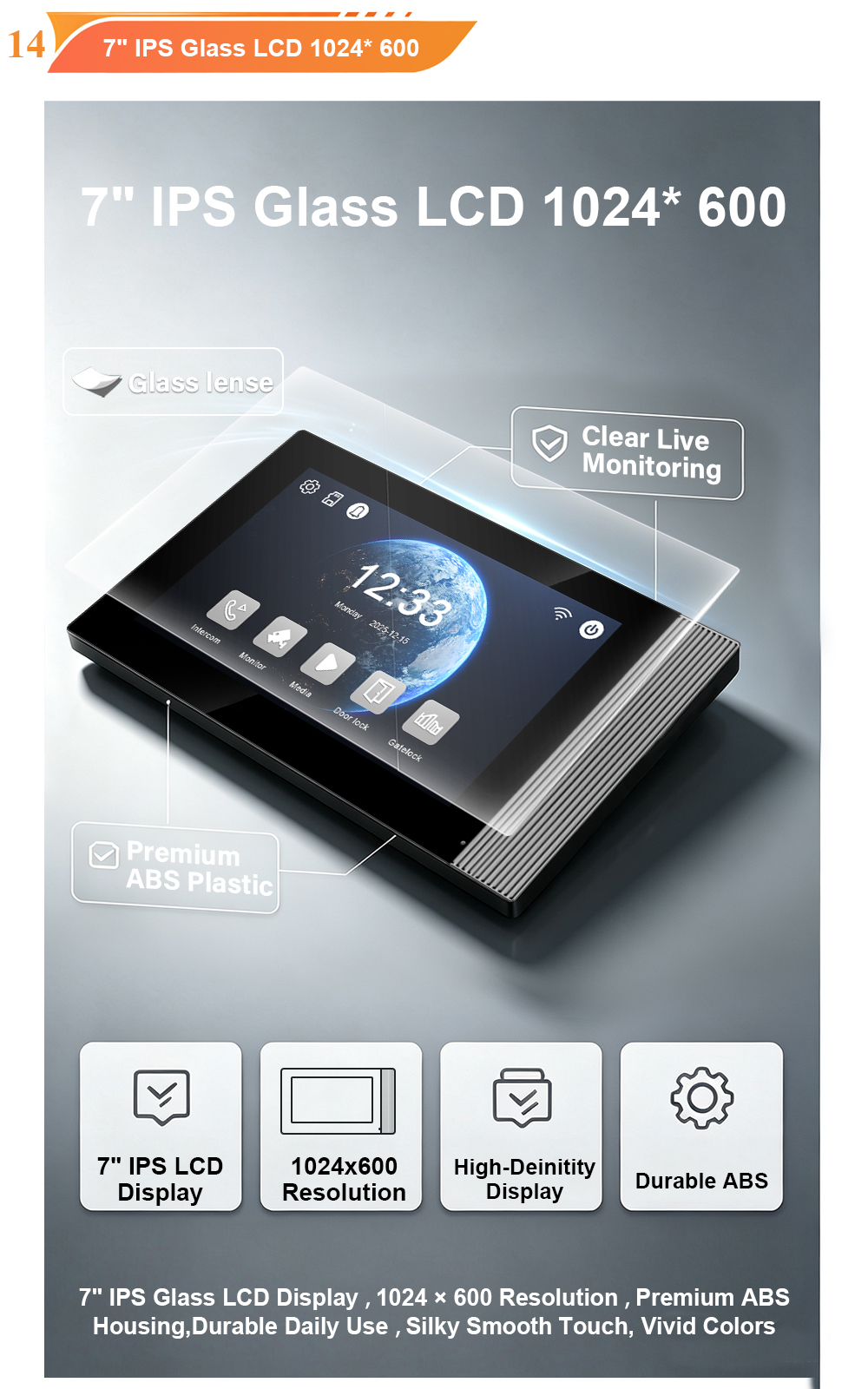
New products. The 10″ indoor monitor with redesigned UI, app binding support, and 128GB memory card support; the 8″ apartment outdoor station with room list display, face recognition, and card unlock; the 8″ Guard Station with USB camera support; the keypad villa outdoor unit with metal casing; and the 4.3″ IPS building entrance outdoor station with integrated rain cover.
Hands-on testing. Interface responsiveness, app binding steps, card reading with the card types used in your market, audio quality at conversational volume, face recognition under different lighting, and call routing across a multi-entrance configuration.
The management center. Card issuance and deletion, face registration, room number configuration, directory generation, and access records—the administrative functions that determine whether a building system is manageable over its lifecycle.
Visitors who have reviewed specifications online often find that the hands-on session confirms some assumptions and corrects others. That is the point of being there.
Afternoon: Commercial and Technical Discussion
The final part of the day is a working session with the sales, engineering, and support teams.
Project-specific configuration. Which architecture fits your building—IP, 2-wire, 4-wire AHD, analog, or wireless—and why. The answer depends on building type, installation stage, distance constraints, and installer skills, not on a universal preference.
OEM/ODM scope. For customized projects: software and hardware development, UI design, functional module adjustments, interface localization, and customized packaging. Because core components are produced in-house, customization can extend beyond branding and packaging—and the engineering team can give a realistic assessment of scope and timeline.
SKD cooperation. For assembly partners, how semi-knocked-down supply would work at your facility, and how it affects production costs and tariff costs.
Certification documentation. CE, FCC, RoHS, IP65, and EMC records for the specific models under consideration, matched to the exact SKU and hardware revision.
Commercial terms. Volume pricing, lead times, payment terms, warranty, and spare parts policy.
After-sales structure. The dedicated technical support group established upon product delivery to assist with programming, device installation, and wiring connections—and how to reach them.
What to Bring and Prepare
A visit is more productive when you arrive with specific questions.
Bring your project documentation—building layouts, unit counts, entry point counts, and any specification documents you are working from.
Bring the credentials your market uses—the specific IC or ID cards, and a phone you would use for app binding and NFC testing. Testing with your own cards and phone is more meaningful than testing with the factory’s.
Bring your certification requirements—the specific standards and documentation your market requires, so the relevant records can be reviewed on site.
Bring your questions—the ones that have been difficult to resolve by email. A factory visit is the most efficient place to get them answered.
Dress for a production floor—closed-toe shoes and practical clothing. Some areas may require ESD protection or safety equipment, which we will provide.
Practical Logistics
Location. FARHD is located on the 6th Floor, Sanhe Sci-Tech Innovation Park, Sanhe Road, Dalang Street, Longhua District, Shenzhen, Guangdong Province, China.
Duration. A focused visit covering the production tour, product testing, and commercial discussion typically takes one full day. Partners evaluating a complex multi-product project or a significant customization may prefer two days.
Language. Visits are conducted in English or Chinese, with support for other languages arranged in advance where needed.
Group size. Visits can accommodate individual partners or small groups. For larger delegations, please let us know in advance so the schedule and meeting rooms can be arranged.
Photography. Photography on the production floor is generally permitted for partner evaluation purposes, with some restrictions in specific areas. Please ask before photographing.
What Partners Usually Take Away
Across visits, a few consistent outcomes emerge.
Clarity on capability. Visitors leave knowing what FARHD produces in-house, what can be customized, and what the realistic boundaries are—which prevents mismatched expectations later in the project.
A tested product, not just a described one. Hands-on testing answers questions that specifications cannot: how the interface actually responds, how the app binding flow feels, whether card reading is reliable with your market’s cards, and whether audio is clear at conversational volume.
A named support channel. Meeting the technical support team in person changes the experience of the first commissioning question.
A documented next step. Each visit ends with a clear record of what was discussed—products, configuration, customization scope, and follow-up actions.
Behind the Visit: The Manufacturing Foundation
What visitors see on the tour is the basis of everything FARHD offers partners.
The company was founded in 1998 and has focused on video door phones and intercom systems for 28 years. It operates as a professional source factory with full in-house R&D and production capabilities—from TFT LCD screens, driver boards, and camera modules to complete villa and apartment building intercom systems. Every unit undergoes a 24-hour aging test before shipment. Products hold international certifications including CE, FCC, RoHS, IP65 water resistance, and EMC.
Supported by 28 direct sales branches across China, FARHD has completed more than 10,000 large-scale building video intercom projects, including ultra-large communities with 1,000, 3,000, and even over 5,000 households—projects in which addressing schemes, directory structures, card management workflows, and documentation requirements are fundamentally different from those of a small building.
OEM and ODM services cover customized software and hardware development, UI design, functional module adjustments, and customized packaging solutions. We provide SKD solutions for assembly factories in Europe, the Middle East, South America, Southeast Asia, the United States, Russia, India, Iran, Turkey, South Korea, and Italy. A hassle-free after-sales service system ensures that upon product delivery, a dedicated technical support group is established to assist with programming, device installation, and wiring connections throughout the process.
A factory visit is how those statements become evidence.
Plan Your Visit
If you are evaluating FARHD for an upcoming project—or simply want to see how a source factory actually builds video intercom systems—we welcome your visit. Please contact our team with your travel dates and the products or projects you want to discuss, and we will prepare a schedule around your priorities.
Whether you are sourcing standard products, exploring OEM/ODM customization, or discussing SKD cooperation for local assembly, a day on the production floor is the most direct way to decide whether we are the right partner for your market.
We look forward to welcoming you in Shenzhen.
📩 Email: [email protected]
🌐 Website: www.farhd.com
📱 WhatsApp: +86 188 2370 9809 / +86 199 2545 1918
Também pode interessar-lhe
-
Rigorous Aging Test for FARHD Villa Video Intercom Outdoor Stations: Continuous Burn-In Before Every Shipment
A villa outdoor station has one job that cannot be compromised: it must work when someone is standing at the gate. Not when the showroom lights are on, not when the unit is fresh out of the box on day one—but on the hundredth day, in the rain, at night, when a resident is expecting…
-
FARHD Video Intercom Performance Test: 100m Ethernet Distance, Crystal Clear Video, and -45°C Extreme Temperature Reliability
Performance claims are easy to make and harder to prove. A datasheet can state that a system supports long cable runs. It can list an operating temperature range. It can describe audio and video quality in general terms. What it cannot do is show what happens when a 100-meter Ethernet cable carries a call between…
-
Every Detail Matters for Reliable Intercom Systems: Inside FARHD’s Production Discipline
Reliability in a video intercom system is rarely decided by a single dramatic feature. It is decided by a long series of small decisions—how a solder joint is formed, whether a gasket sits correctly, whether a unit was tested for a full day before it was packed, whether the documentation that accompanies a shipment matches…
-
Smart Video Intercom: See. Talk. Unlock. A Smarter and Safer Living Experience
Every interaction at a building entrance comes down to three actions. Someone outside asks to be let in. Someone inside needs to see who it is, speak to them, and decide. That is the whole of it—see, talk, unlock—and yet the difference between a system that does these three things well and one that does…