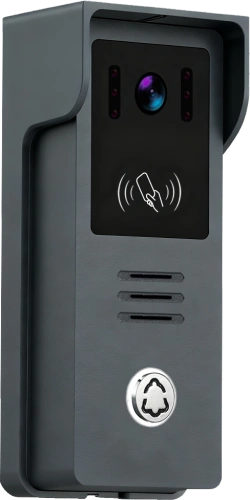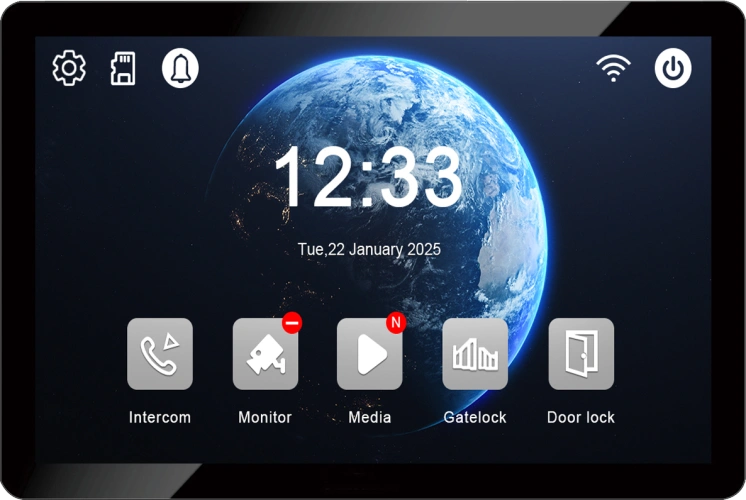
New 4-Wire Connection Indoor Monitor: Touch Screen Control, Up to 4 Indoor Monitors and 2 Call Panels
نوفمبر 24, 2026
شارك هذه المقالة
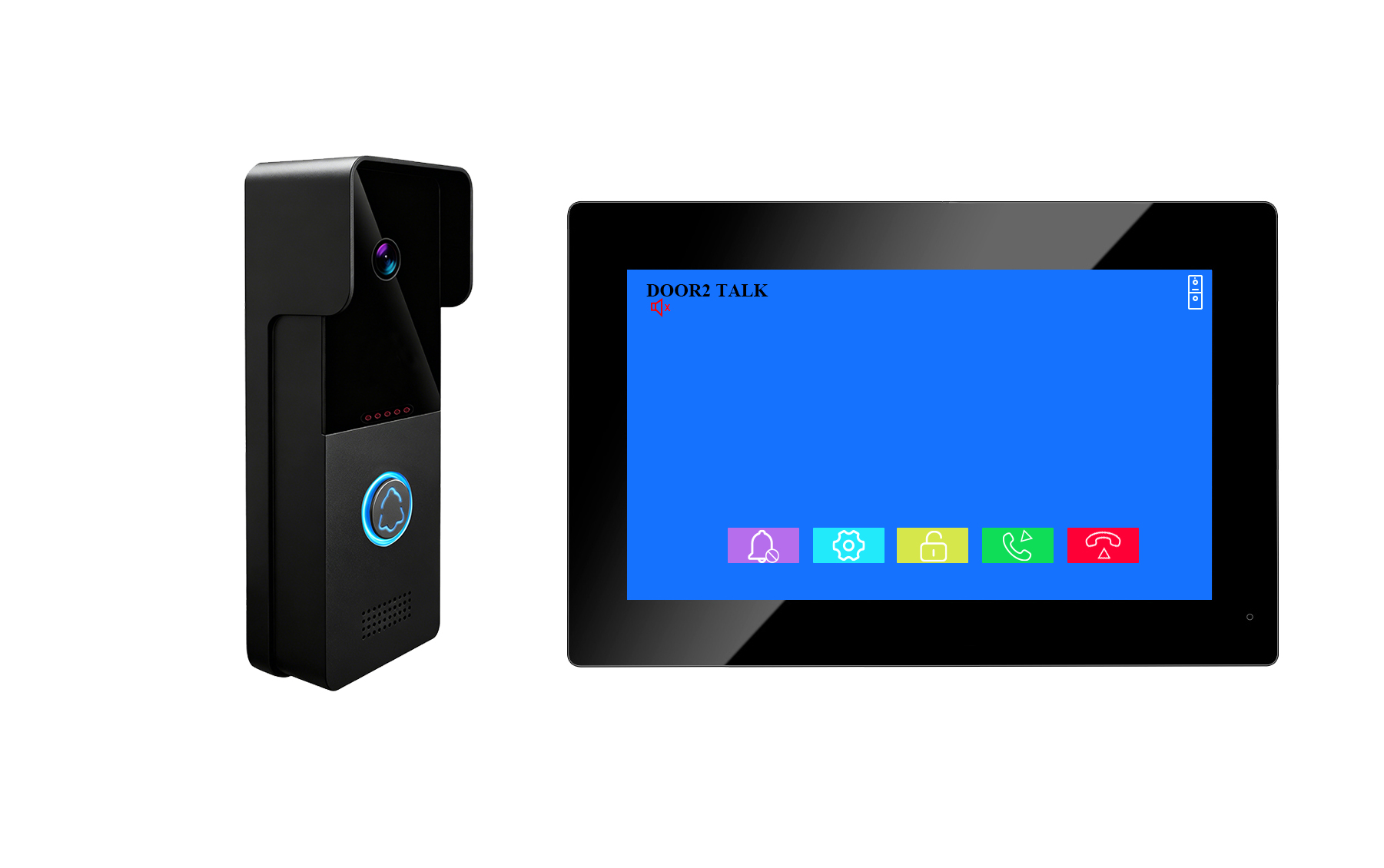
A villa intercom system rarely involves just one screen in one room. The homeowner wants to answer the gate from the entrance hall, the kitchen, the master bedroom, and perhaps a home office. There may be a second entry point—a garden door, a service entrance, or a garage—that also needs a call panel. The system has to cover all of these without becoming a patchwork of separate devices, and without requiring the installer to rip open finished walls to run new cable.
FARHD’s new 4-wire connection indoor monitor is designed for exactly this scenario. It combines a touch screen interface with the capacity to support up to 4 indoor monitors and 2 call panels on a single 4-wire system—giving villa and residential projects the coverage they need without the complexity of a networked architecture.
FARHD has manufactured video door phones and intercom systems since 1998, with 28 years of experience and full in-house R&D and production of core components—including TFT LCD screens, driver boards, and camera modules. That vertical integration allows the monitor, the call panels, and the system architecture to be designed as one coordinated system.
Why 4-Wire Still Matters in Villa Projects
IP systems get most of the attention in industry conversations, but 4-wire systems remain a practical choice for a large share of villa and residential projects—and for good reasons.
Installer familiarity. 4-wire systems use dedicated conductors for power, audio, video, and control. The architecture is well understood by installers, does not depend on network configuration, and behaves predictably in the field.
No network dependency. There is no switch to configure, no VLAN to segment, no QoS to tune, and no risk of a network fault taking the intercom offline. For projects where the building’s IT infrastructure is managed by a third party—or does not exist yet—this independence is valuable.
Predictable performance. A 4-wire system does not share bandwidth with other building systems. Call quality, video clarity, and unlock response are determined by the devices and the cable, not by network conditions.
Cost profile. For a single villa or a small residential project, a 4-wire system can be more cost-effective than a full IP deployment, particularly when the cabling is planned during construction.
Straightforward troubleshooting. When something goes wrong, the diagnostic path is shorter: check the cable, check the terminations, check the device. There is no network layer to investigate.
The new 4-wire indoor monitor is designed to make the most of these advantages—while adding the interface quality and system capacity that modern projects expect.
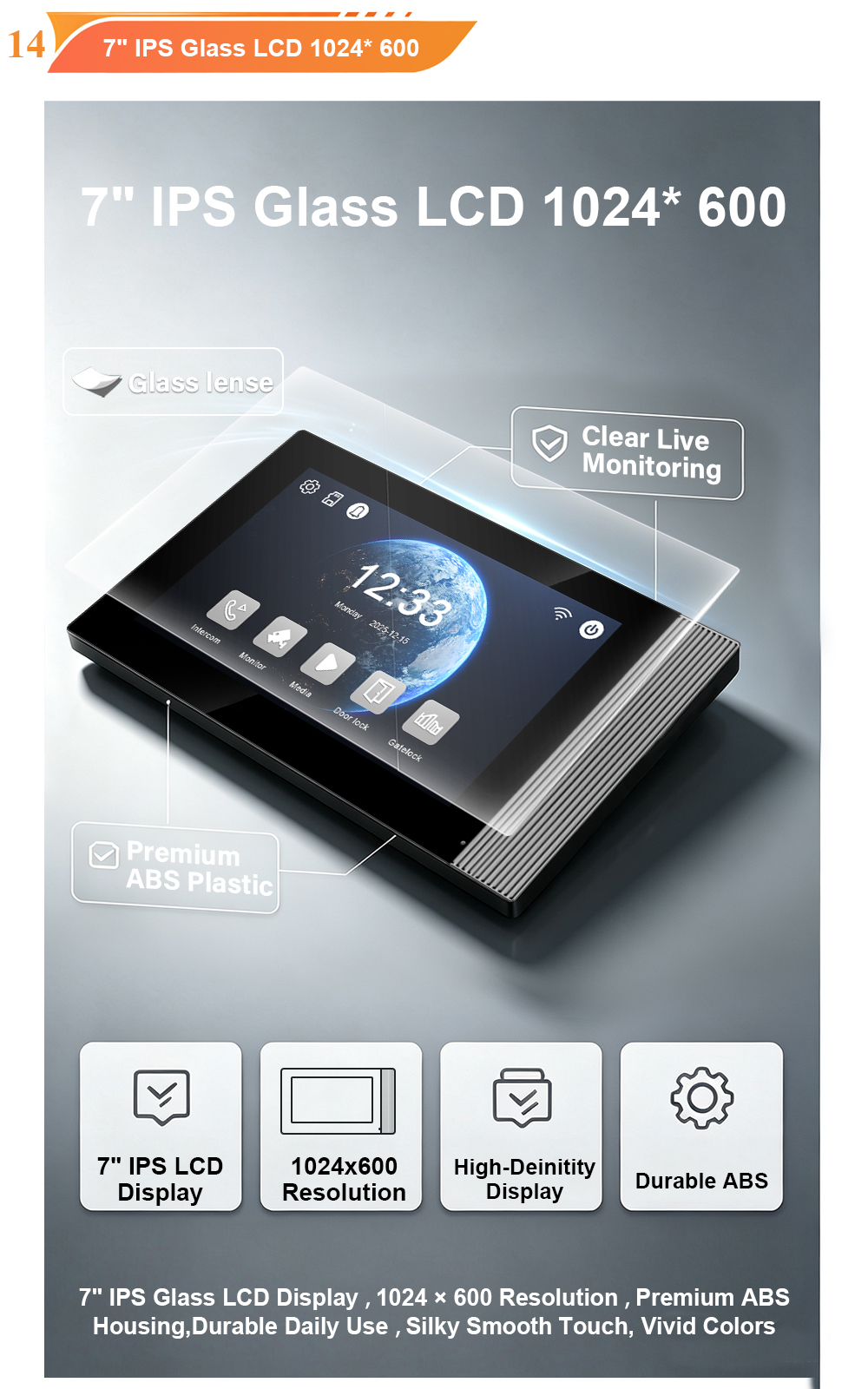
Touch Screen Control: A Modern Interface on a Proven Architecture
The touch screen is the most visible upgrade in this monitor. It changes how residents interact with the system in ways that matter daily.
Clear Display and Direct Interaction
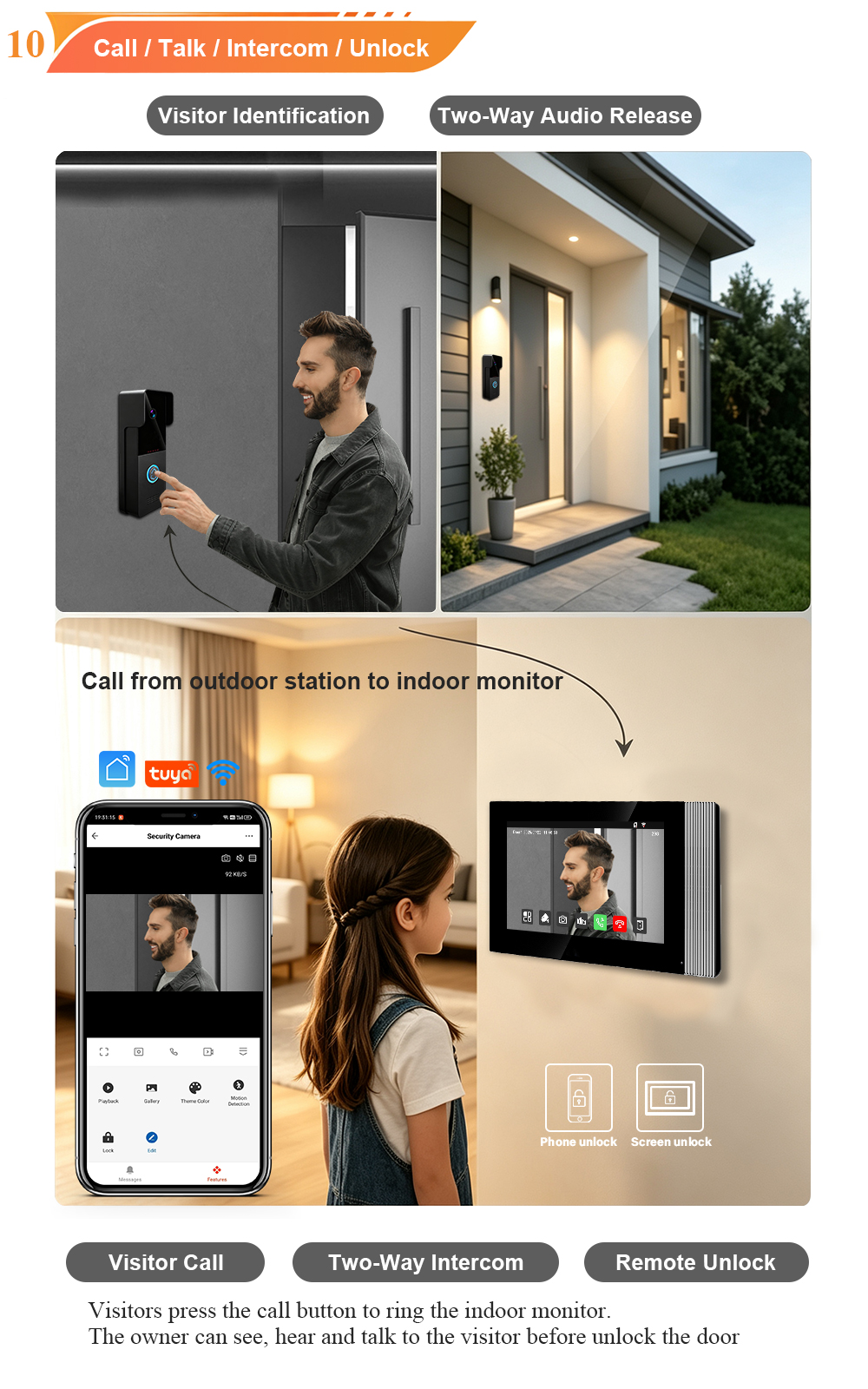
The touch screen presents the visitor image prominently, with answer and unlock controls available directly. Residents do not have to hunt for a physical button mapped to a function they have forgotten—the interface presents the right options at the right time.
Touch controls sized for fingers reduce mis-taps and make the monitor feel like a modern smart-home device rather than a technical panel. For elderly residents or children, the simplified interaction reduces the effort needed to answer a call or unlock a door.
Simplified Navigation
A logical menu structure makes settings, call history, and device configuration easier to find. The interface is designed around the functions residents use most: answering calls, viewing video, unlocking doors, and checking who called.
Multi-Monitor Consistency
When the system supports up to 4 indoor monitors, the interface has to work consistently across all of them. A shared interface design means residents encounter the same logic whether they are answering from the entrance hall or the master bedroom—no relearning required.
Because FARHD produces TFT LCD screens in-house, display quality—brightness, viewing angle, color accuracy, and touch response—is controlled at the component level. For a device used dozens of times a day and expected to last years, that control matters.
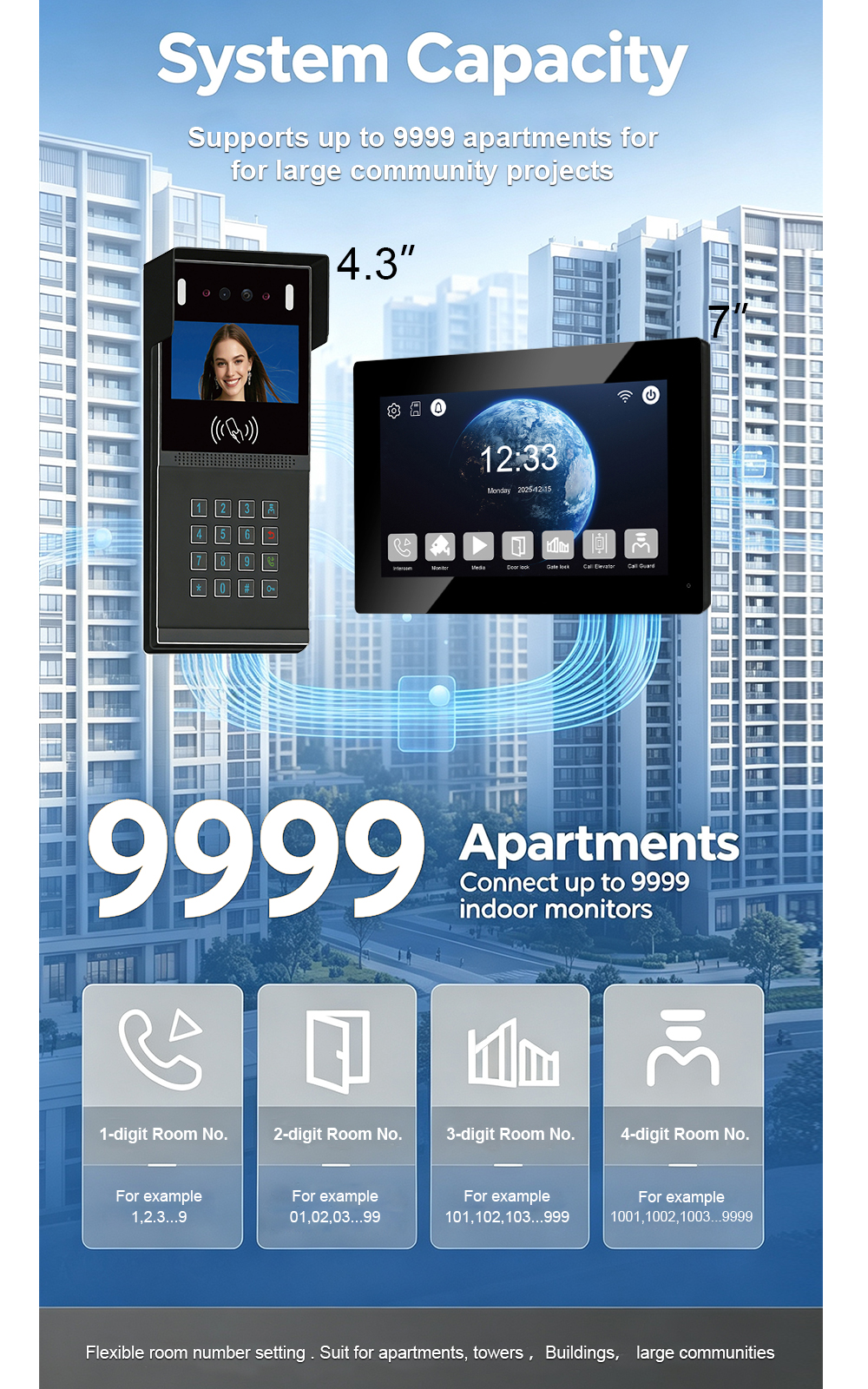
System Capacity: Up to 4 Indoor Monitors and 2 Call Panels
The capacity specification is what makes this monitor suitable for larger villas and multi-entry properties. It is worth explaining what it means in practice.
Up to 4 Indoor Monitors
A single villa can have monitors in multiple locations—typically the entrance hall, the kitchen, the master bedroom, and a secondary living area or home office. Each monitor provides the same core functions: seeing the visitor, speaking to them, and unlocking the door.
Why multiple monitors matter:
- Convenience. The resident answers from wherever they are, rather than walking to a single monitor location.
- Coverage. In a large villa, a single monitor may be far from where the family spends time.
- Redundancy. If one monitor is being serviced or fails, the others remain functional.
- Multi-floor coverage. In a multi-storey villa, monitors on different floors ensure the gate can be answered from anywhere.
Practical considerations:
- Call routing. When a call comes in, the system should ring the monitors in a way that makes sense—all monitors, or a defined subset. The configuration should be set during commissioning based on how the household actually lives.
- Consistent configuration. All monitors should be configured consistently, so that the resident experience is the same regardless of which monitor they use.
- Cable planning. A 4-wire system supporting 4 monitors requires planned cabling. In new construction, this is straightforward; in retrofits, the cable route should be confirmed before installation.
Up to 2 Call Panels
The ability to connect 2 call panels means the system can cover two separate entry points—for example:
- Main gate and garden door — the two most common villa entry points, each with its own call panel.
- Main gate and garage — where vehicle access and pedestrian access are separate.
- Front entrance and service entrance — where staff or deliveries use a different door.
- Main gate and a secondary building — where a pool house, guest house, or outbuilding has its own entrance.
Why two call panels matter:
- Multi-entrance coverage. A villa with more than one entry point needs each to be covered; a single panel leaves a blind spot.
- Independent identification. The indoor monitors should clearly identify which panel is calling—so the resident knows whether to expect a visitor at the main gate or a delivery at the service door.
- Independent unlock control. Each panel’s associated lock should be releasable independently, so unlocking the garden door does not release the main gate.
- Complete property coverage. Two panels cover the typical villa layout without requiring a second system.
Combined Capacity: What It Enables
The combination of 4 indoor monitors and 2 call panels supports a complete villa entry system:
| Configuration | Entry points covered | Monitor locations |
|---|---|---|
| 1 panel + 1 monitor | Single entrance | Single location |
| 1 panel + 4 monitors | Single entrance | Entrance hall, kitchen, bedroom, office |
| 2 panels + 1 monitor | Main gate + garden door | Single location |
| 2 panels + 4 monitors | Main gate + garden door | Entrance hall, kitchen, bedroom, office |
The full configuration—2 call panels and 4 indoor monitors—covers both entry points and gives the household the ability to answer from anywhere in the villa. That is the configuration that suits larger villas and properties with multiple entry points.
Where This Monitor Fits
The new 4-wire indoor monitor is positioned for villa and residential projects, and it suits a range of applications:
Large villas with multiple entry points — the primary use case, where 2 call panels cover the main gate and a secondary entrance, and 4 monitors provide coverage across the property.
Multi-storey villas — where monitors on different floors ensure the gate can be answered from anywhere.
Villas with outbuildings — where a pool house, guest house, or garage has its own entrance and needs coverage.
Townhouses and semi-detached homes — where a single entry point with multiple monitors provides convenience across the property.
Small residential projects — where a 4-wire system offers a cost-effective alternative to IP deployment while still providing multi-monitor coverage.
مشاريع التحديث — where 4-wire cabling can be reused or installed with minimal disruption.
For integrators, one monitor that supports multiple units and panels simplifies specification and stocking. For distributors, it means a product that fits the villa segment without requiring a separate product line for each layout.
Installation Considerations for 4-Wire Systems
A 4-wire system is straightforward to install, but a few practical points determine whether it works well.
Cable planning before installation. With up to 4 monitors and 2 panels, the cabling layout should be planned before installation begins. Confirm the route from each call panel to the monitor distribution point, and from that point to each monitor location.
Consistent termination. 4-wire systems depend on correct termination at each device. Confirm polarity, secure connections, and avoid stray conductor strands that can short against adjacent terminals.
Call routing configuration. Decide during commissioning how calls should be routed—whether all monitors ring, or a defined subset. Document the configuration in the handover file.
Lock integration. Each call panel may connect to a different lock type—electric strike, magnetic lock, or gate controller. Confirm the relay configuration and current ratings for each lock.
Power supply. Confirm the system power supply meets the requirement for the total device count. With 4 monitors and 2 panels, the power draw is higher than a single-device system, and the supply should be sized accordingly.
Testing. Test each call panel to each monitor, confirm audio and video quality, and verify independent unlock control for each entry point.
Backed by FARHD’s Manufacturing Foundation
The new 4-wire indoor monitor comes from FARHD, a professional video intercom manufacturer founded in 1998 with 28 years of experience in video door phones and intercom systems.
FARHD specializes in full in-house R&D and production—from TFT LCD screens, driver boards, and camera modules to complete villa and apartment building intercom systems. The product line covers IP intercom systems for villas and apartments, 2-wire IP systems, 4-wire CVBS and AHD systems, analog apartment systems, wireless video doorbells, audio intercom systems, and various kits.
Products hold international certifications including CE, FCC, RoHS, IP65 water resistance, and EMC. Every unit undergoes a 24-hour aging test before shipment—a production step that catches early-life defects in the factory rather than at a resident’s gate.
Supported by 28 direct sales branches across China, FARHD has completed over 10,000 large-scale building video intercom projects, including ultra-large communities with 1,000, 3,000, and even over 5,000 households. That project experience informs products designed for real installation and usage conditions.
For partners building a private-label product line, OEM and ODM services cover customized software and hardware development, UI design, functional module adjustments, and tailored packaging solutions. Because core components are produced in-house, customization can extend beyond branding and packaging to display specifications, driver board configuration, and functional behavior. SKD solutions are available for assembly factories across Europe, the Middle East, South America, Southeast Asia, the United States, Russia, India, Iran, Turkey, South Korea, and Italy, helping reduce production and tariff costs.
A hassle-free after-sales service system ensures that upon product delivery, a dedicated technical support group is established to assist with programming, device installation, and wiring connections throughout the process.
A Complete Villa Entry System on a Proven Architecture
The new 4-wire connection indoor monitor brings together the elements that villa projects need: a modern touch screen interface, the capacity to support up to 4 indoor monitors and 2 call panels, and the reliability of a 4-wire architecture that installers understand and that does not depend on network infrastructure.
For distributors, integrators, and developers evaluating it for upcoming villa or residential projects, the next step is a sample and a conversation about the specific property—number of entry points, monitor locations, lock types, and installation conditions. Those details determine the configuration, and they are best discussed before the specification is finalized.
Samples and technical documentation are available on request.
We look forward to building a strong partnership with you and jointly shaping the future of smart living.
📩 Email: [email protected]
🌐 Website: www.farhd.com
📱 WhatsApp: +86 188 2370 9809 / +86 199 2545 1918
قد يثير اهتمامك أيضًا
-
Rigorous Aging Test for FARHD Villa Video Intercom Outdoor Stations: Continuous Burn-In Before Every Shipment
A villa outdoor station has one job that cannot be compromised: it must work when someone is standing at the gate. Not when the showroom lights are on, not when the unit is fresh out of the box on day one—but on the hundredth day, in the rain, at night, when a resident is expecting…
-
FARHD Video Intercom Performance Test: 100m Ethernet Distance, Crystal Clear Video, and -45°C Extreme Temperature Reliability
Performance claims are easy to make and harder to prove. A datasheet can state that a system supports long cable runs. It can list an operating temperature range. It can describe audio and video quality in general terms. What it cannot do is show what happens when a 100-meter Ethernet cable carries a call between…
-
Every Detail Matters for Reliable Intercom Systems: Inside FARHD’s Production Discipline
Reliability in a video intercom system is rarely decided by a single dramatic feature. It is decided by a long series of small decisions—how a solder joint is formed, whether a gasket sits correctly, whether a unit was tested for a full day before it was packed, whether the documentation that accompanies a shipment matches…
-
Smart Video Intercom: See. Talk. Unlock. A Smarter and Safer Living Experience
Every interaction at a building entrance comes down to three actions. Someone outside asks to be let in. Someone inside needs to see who it is, speak to them, and decide. That is the whole of it—see, talk, unlock—and yet the difference between a system that does these three things well and one that does…