S76-WL + V3-WL Wireless Video Intercom: 915MHz Performance Test Reveals Real‑World Reliability
octobre 5, 2026
Partager cet article
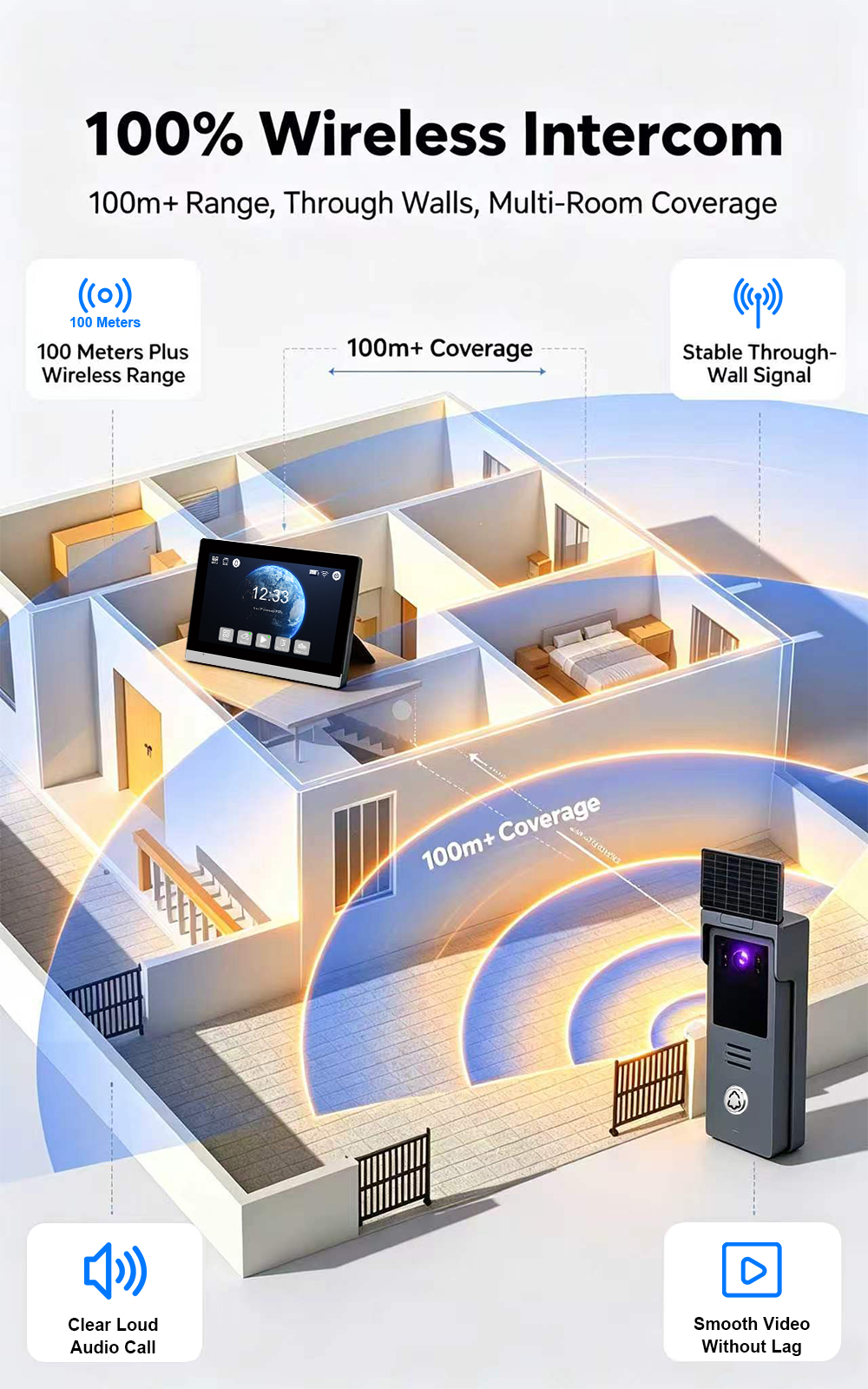
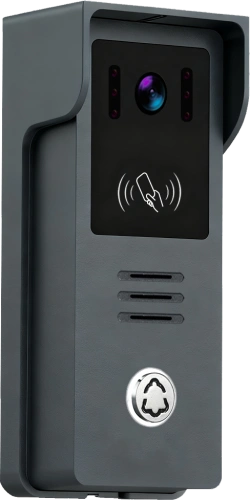
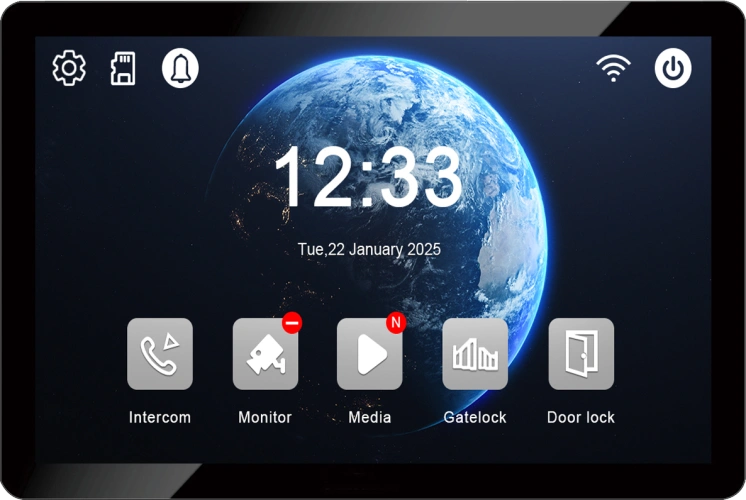
When you choose a wireless video intercom, you need to know how it performs in the real world—not just in a lab. We recently conducted a comprehensive comparison test of 915MHz wireless video doorbells, including our S76-WL + V3-WL model, to evaluate communication distance, interference resistance, and audio quality. The results confirm what we’ve always believed: our products deliver stable, reliable performance, and any variation in range is due to environmental factors—not product defects.
In this blog, we share the test methodology, key findings, and practical installation recommendations. Whether you’re a system integrator, property developer, or end user, this data will help you understand what to expect from 915MHz wireless intercoms—and why FARHD’s S76-WL + V3-WL is a smart choice for your next project.
Test Overview
Date: September 14, 2026
Objective: To evaluate the real‑world performance of 915MHz wireless video intercoms by measuring maximum effective communication distance, interference resistance, and two‑way audio quality—and to compare our S76-WL + V3-WL with competing products.
Equipment tested: Multiple 915MHz wireless video doorbell sets, including our S76-WL + V3-WL, with indoor monitors and outdoor door stations at various battery levels. One competitor device was also included.
Test environments:
- Outdoor parking lot on the 1st floor (high‑rise corridor, open air)
- Indoor office building (factory internal workshop)
Weather conditions: Overcast to cloudy, no direct sunlight, temperature 25–32°C, light breeze.
Test 1: Communication Distance
Method: Step‑by‑step distance pull test. Starting at 20‑meter increments, we identified the farthest point at which voice and data packets were stably received by the door station. Three tests were averaged for each environment.
Résultats :
| Device Model | Outdoor Parking Lot (m) | Indoor Workshop (m) |
|---|---|---|
| Wireless Device 1–3 | — | — |
| Wireless Device 4 | 20 (2:30 PM) / 50 (4:30 PM) | 40 (2:30 PM) |
| Wireless Device 5 | — | — |
| Competitor Device | 50 (4:30 PM) | — |
Key finding: The same device, in the same location, achieved only about 20 meters at 2:30 PM when the sun was direct, the parking lot was busy, and traffic on the nearby road was heavy. But at 4:30 PM, under the same conditions, the range recovered to 50–60 meters.
Analysis: This variation is not a product defect. 915MHz operates in an open ISM band, and its range fluctuates with real‑time electromagnetic and propagation conditions. At 2:30 PM, direct sunlight heated the device, while heavy traffic introduced metal‑body multipath reflection, engine and vehicle electronic noise, and co‑channel interference from other wireless devices. These factors raised the environmental noise floor and reduced the received signal‑to‑noise ratio, compressing the effective range to about 20 meters. By 4:30 PM, changes in sun angle, temperature, traffic density, and surrounding wireless activity reduced interference, and the range returned to 50–60 meters.
Conclusion: The 20‑meter result was an instantaneous performance under strong interference, not the inherent communication distance of the product.
Test 2: Communication Distance (Standard Environment)
Method: Same step‑by‑step pull test, conducted in a high‑rise corridor outdoor environment and an office building indoor environment. Three tests averaged.
Résultats :
| Device Model | High‑Rise Corridor Outdoor (m) | Office Building Indoor (m) |
|---|---|---|
| Wireless Device 1 | 80 | 50 |
| Wireless Device 2 | 80 | 50 |
| Wireless Device 3 | 80 | 50 |
| Wireless Device 4 | 80 | 50 |
| Wireless Device 5 | 80 | 50 |
| Competitor Device | 80 | 50 |
Key finding: In standard, open, interference‑free environments, all tested devices—including our S76-WL + V3-WL—achieved the designed communication distance: 80 meters outdoors and 50 meters indoors. This confirms that our products meet their RF specifications and are stable and reliable when installed in typical conditions.
Installation recommendation: To maximize performance, mount devices as high as possible, avoid pointing antennas toward heavy traffic or metal obstructions, keep antennas vertical, and avoid direct sunlight.
Test 3: Two‑Way Audio Quality
Method: In an office building indoor environment, we tested two‑way audio between the indoor monitor and the outdoor door station at a distance of 30 meters.
Résultats :
| Condition | Indoor Input Volume | Indoor Output Volume | Echo? | Notes |
|---|---|---|---|---|
| Default | 7 | 8 | Oui | Test distance 30m |
| Lower input, output unchanged | 6 | 8 | Non | Door station sound is low |
| Input unchanged, lower output (1st) | 7 | 7 | Oui | Test distance 30m |
| Input unchanged, lower output (2nd) | 7 | 6 | Slight echo | Test distance 30m |
| Input unchanged, lower output (3rd) | 7 | 5 | Non | Normal audio quality |
Key finding: With default volume settings, some echo was present. By adjusting the indoor monitor’s input or output volume, echo was eliminated while maintaining clear two‑way communication. The optimal setting for clear audio without echo was input 7, output 5.
Recommandation : During installation, fine‑tune the volume levels to match the acoustic environment. This ensures clear conversation without echo or feedback.
What This Means for Your Projects
The test results demonstrate three important points:
- Our S76-WL + V3-WL meets design specifications. In standard environments, it achieves 80 meters outdoors and 50 meters indoors—performance that matches or exceeds competing products.
- Environmental interference is temporary and manageable. The 20‑meter result under strong interference was an instantaneous condition, not a fixed limitation. With proper installation (elevated mounting, antenna orientation, avoiding direct sun and traffic), performance remains reliable.
- Audio quality is adjustable. Echo can be easily eliminated by tuning volume settings, ensuring clear communication in any installation.
These findings give us confidence—and should give you confidence—that the S76-WL + V3-WL is a dependable wireless video intercom solution for villas, apartments, and residential projects.
Why Choose FARHD’s S76-WL + V3-WL?
- Proven 915MHz technology – Stable, interference‑resistant, and widely used in wireless intercoms.
- Rigorous testing – Every unit is tested for RF performance, audio quality, and reliability before shipment.
- Real‑world performance – Designed to meet the demands of diverse installation environments.
- une prise en charge OEM/ODM – Custom branding, packaging, and software available.
- Factory‑direct pricing – Competitive costs, full quality control.
- Certifications mondiales – CE, FCC, RoHS, and more.
Whether you’re equipping a single villa or a large residential complex, the S76-WL + V3-WL delivers reliable wireless communication with the flexibility to adapt to your project.
Ready to Learn More?
If you’d like to receive the full test report, discuss installation best practices, or request a sample for your own evaluation, our team is ready to help.
📩 Email: [email protected]
🌐 Website: www.farhd.com
📱 WhatsApp: +86 188 2370 9809 / +86 199 2545 1918
FARHD – Video Intercom Manufacturer Since 1998.
#WirelessVideoIntercom #915MHz #S76WL #V3WL #VideoDoorPhone #IntercomTesting #FARHD #OEM #ODM #BuildingSecurity
Vous pourriez également être intéressé par
-
2-Wire Video Door Phone Connection with Electric Rim Lock: Unlock by Card, Indoor Monitor, and App
A complete guide to wiring an electric rim lock to a FARHD 2-wire video door phone system—and configuring three convenient unlock methods: RFID card, indoor monitor, and mobile app. Whether you are upgrading an existing building or specifying a new system, this guide covers the essentials for reliable, secure access control. Electric rim locks are…
-

Video Intercom Manufacturer & Source Factory Since 1998 | OEM ODM SKD Building Intercom
Video Intercom Manufacturer & Vertical Source Factory in China FARHD is a professional video intercom manufacturer with over 28 years of specialized experience in building security intercom systems. Established in 1998, we are a genuine building intercom factory focused on independent R&D, in-house production, and customized manufacturing for global B2B clients, including distributors, importers, engineering contractors, real estate…
-
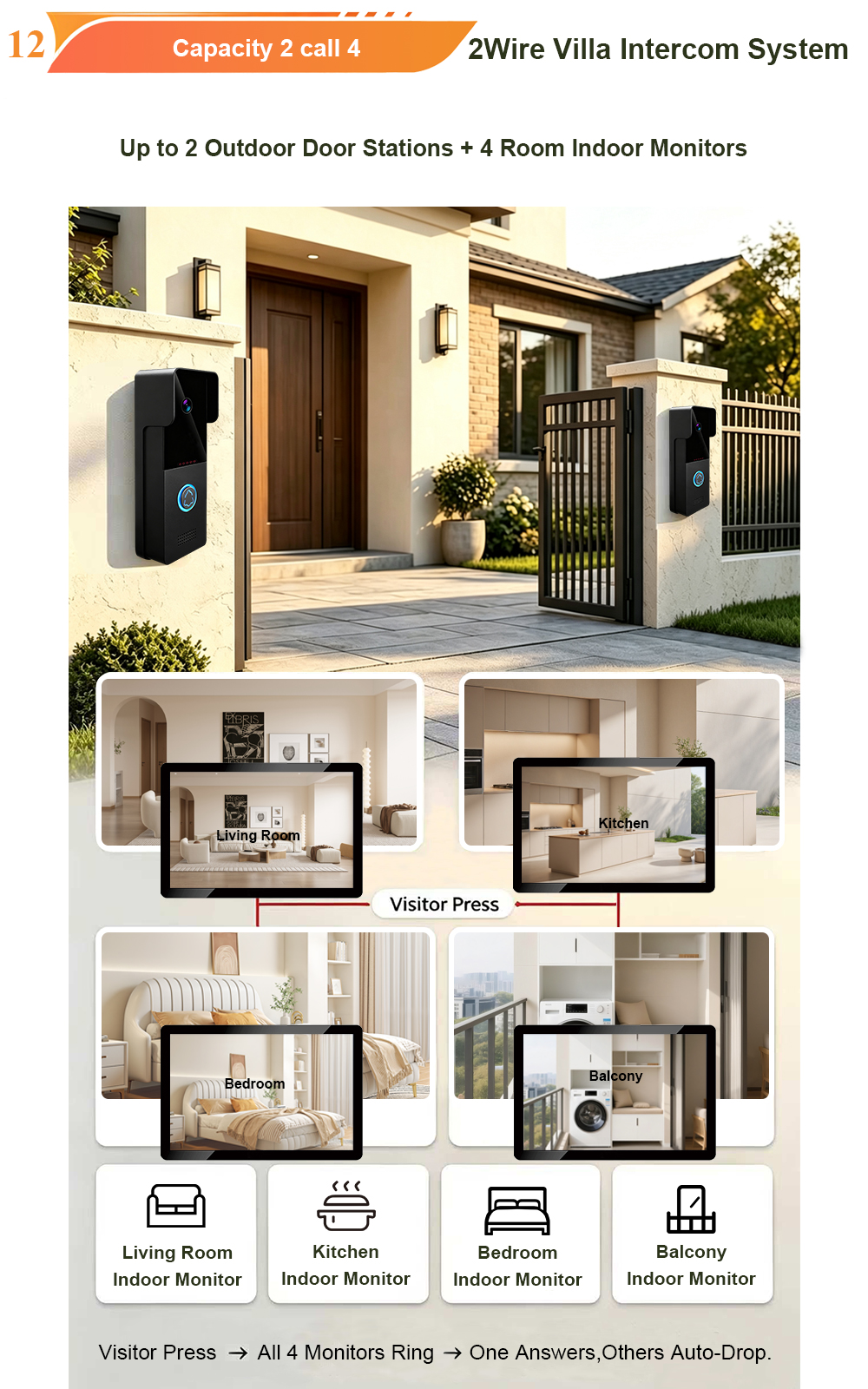
FARHD Video Intercom System: Versatile Solutions for Apartments and Villas
When it comes to building security and smart access, one size does not fit all. Different buildings have different wiring, different layouts, and different resident expectations. That’s why FARHD offers a comprehensive range of video intercom systems—with various indoor monitors and outdoor stations to match any apartment or villa project. Since 1998, FARHD has been…
-
Low-Temperature Test: FARHD Video Intercom Screens Keep Running Smoothly in Freezing Cold
Inside the freezing chamber, it keeps working — normal display, no black screen, no shutdown. Real quality isn’t just about lab data; it’s about staying reliable in extreme conditions. A video intercom that withstands freezing cold — because your door security can’t take a day off. In many parts of the world, winter is not…