Smart Video Intercom: See. Talk. Unlock. A Smarter and Safer Living Experience
noviembre 23, 2026
Comparte este artículo
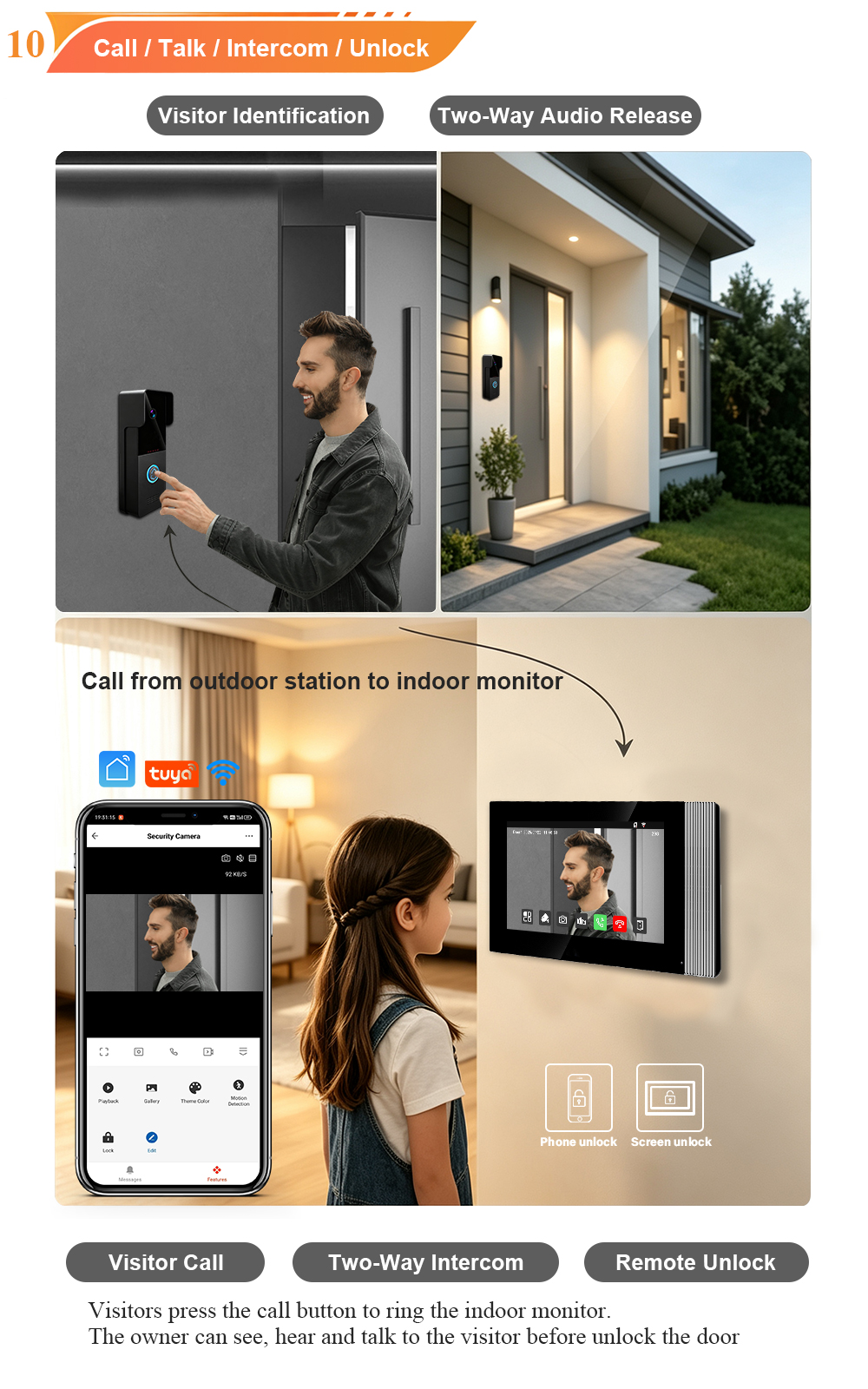
Every interaction at a building entrance comes down to three actions. Someone outside asks to be let in. Someone inside needs to see who it is, speak to them, and decide. That is the whole of it—see, talk, unlock—and yet the difference between a system that does these three things well and one that does them poorly determines whether residents trust their entrance or work around it.
A smart video intercom does not reinvent those three actions. It makes each of them faster, clearer, and more reliable—and then connects them to everything else the building needs: mobile access, access records, credential management, and the coordination between the gate, the lobby, and the apartment door. The result is not simply a doorbell with a screen. It is a smarter and safer living experience, delivered through three actions that have to work every single time.
FARHD has manufactured video door phones and intercom systems since 1998, with 28 years of experience and full in-house R&D and production of core components—including TFT LCD screens, driver boards, and camera modules. That manufacturing depth is what allows the three actions below to be engineered as one coordinated system rather than assembled from parts with different priorities.
See: The Camera and Display That Make Verification Possible
The first action is seeing. Everything that follows depends on it—if the resident cannot identify the person at the door, the conversation and the unlock decision are guesswork.
What “Seeing” Actually Requires
A camera that performs in real conditions. Villa gates and apartment entrances are not showrooms. They are shaded, sunlit, backlit, and used after dark. A camera that produces a usable image at noon and an unusable one at 9 p.m. fails at the moment security matters most. Infrared night vision, appropriate sensor selection, and careful lens alignment are what extend performance past sunset.
A wide enough field of view. Visitors do not stand precisely centered. They approach from the side, hold packages that occupy part of the frame, or stand slightly off-axis. A wide viewing angle captures the person and their context rather than a narrow slice of the doorway.
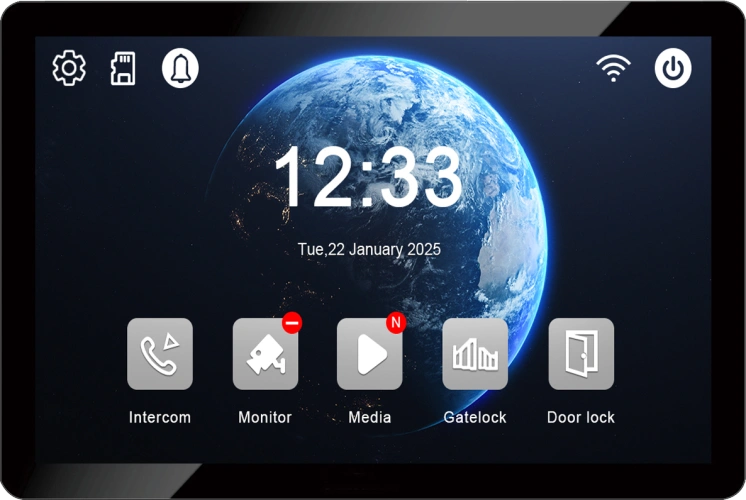
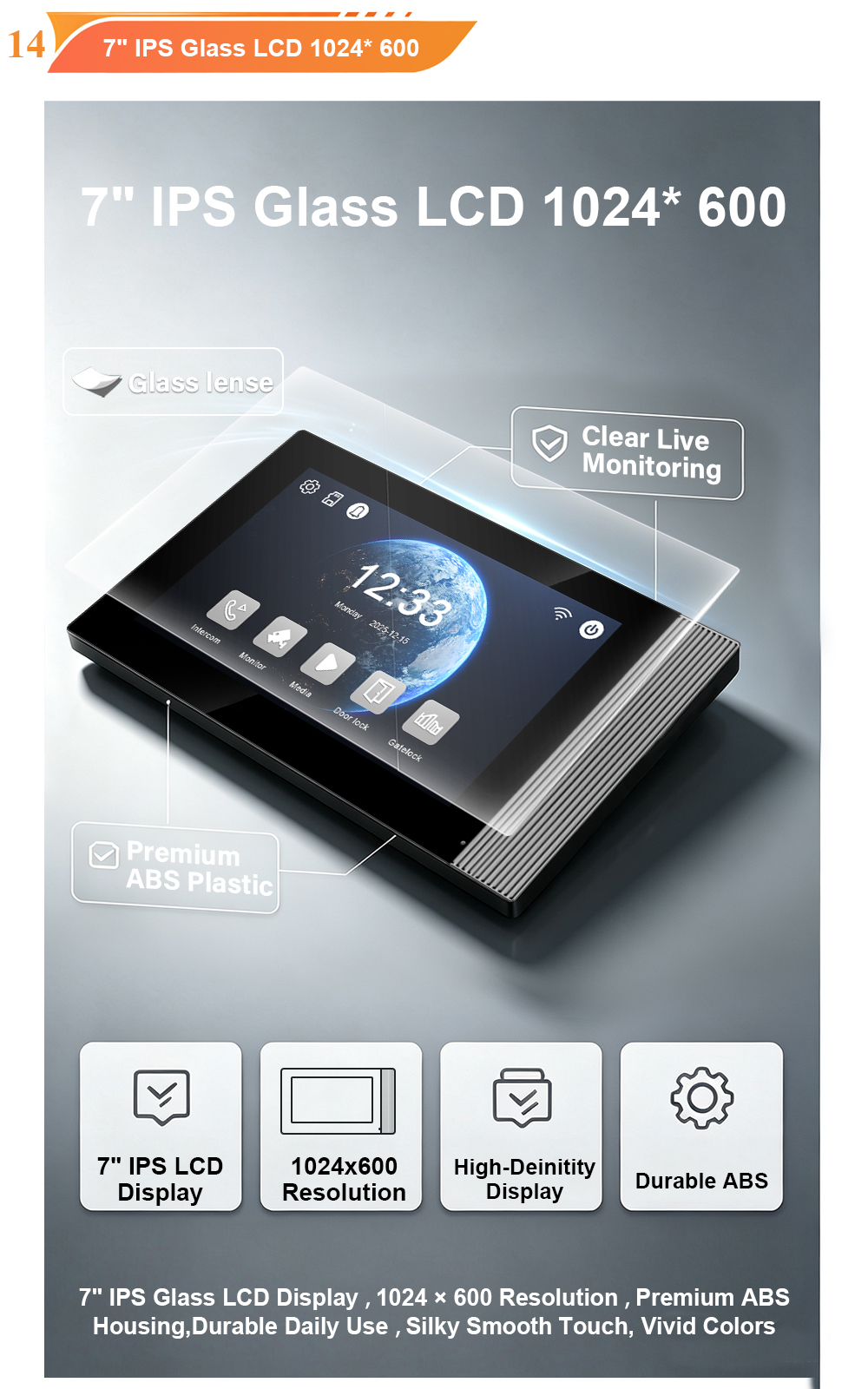
A display that stays readable. The indoor monitor has to render that image clearly—bright enough to read in a lit room, with viewing angles that hold up when the resident is not directly in front of it. IPS panel technology and controlled brightness matter more than resolution alone.
Rendering that fits the interface. In international communities, the display must render prompts and resident names legibly across scripts—Latin, Cyrillic, Arabic, Chinese—without truncation.
Because FARHD produces TFT LCD screens and camera modules in-house, image quality and display performance are tuned at the component level rather than accepted as whatever a third-party supplier delivers. That control is what makes “see” reliable rather than merely present.
Talk: Audio Quality Is the Hardest Part to Get Right
The second action is talking—and it is the part of a video intercom system most often under-specified and most often complained about.
Why Audio Fails in the Field
Residents do not evaluate camera resolution or network architecture. They evaluate whether they can hear the visitor clearly and whether the conversation feels natural. When audio underperforms, the symptoms are consistent:
Echo. The resident hears their own voice returned after a delay, because the speaker output is picked up by the microphone and re-transmitted.
Feedback (howling). A continuous squeal caused by the loop gain between speaker and microphone exceeding a threshold—typically a volume or placement problem.
Drop-out and hiss. Intermittent audio or background noise that makes conversation tiring, often caused by wiring, grounding, or network quality in IP systems.
Inconsistent performance between units. In a building with hundreds of monitors, variation between devices is one of the most common sources of complaints, because residents in different units compare notes.
What Good Audio Requires
Effective acoustic echo cancellation (AEC). The signal processing that removes speaker output from the microphone signal. Without it, full-duplex conversation is very likely to produce feedback.
Appropriate duplex behavior. Half-duplex operation avoids many echo problems by switching transmission between the two ends; full-duplex feels more natural but depends on effective AEC. The right choice depends on the environment.
Sensible default settings. Excessive volume and maximum microphone gain are the leading causes of both echo and feedback. Conservative defaults, with documented adjustment procedures, prevent a large share of field complaints.
Network quality in IP systems. For IP intercoms, end-to-end latency should stay under 300 ms, packet loss under 1%, and jitter controlled. QoS prioritization for voice traffic is not optional on a shared network.
Consistent hardware. In-house production of driver boards and audio components supports the same behavior from the first unit to the thousandth.
Unlock: Access Methods That Match How People Actually Enter
The third action is unlocking—and it is where a smart intercom becomes an access control system rather than a doorbell.
One Entrance, Many Users
No single access method serves everyone in a building. A smart system supports several, so each user takes the path that fits them:
Reconocimiento facial for hands-free entry when carrying shopping, a child, or a bicycle—and for speeding up entry at high-traffic entrances.
Card access as the workhorse of residential entry: fast, familiar, and usable by residents, staff, and contractors without biometric enrollment.
Mobile NFC and app-based unlock for households where the phone is the primary device, and for remote unlocking when the resident is away.
Password access for temporary situations—a contractor, a delivery, a guest—without issuing a physical credential.
Room list call for visitors, who need to reach the right apartment without staff assistance.
The Management Side of Unlock
Access control is only as good as the people managing it. The features that matter operationally are less visible than the unlock methods themselves:
Easy card addition and deletion, so that property managers can issue credentials to new residents and remove them promptly when someone leaves. The most common access control gap in residential buildings is a departed tenant’s card that remains active because removing it was inconvenient.
Face enrollment and deletion with records, including consent documentation, so that biometric data is managed according to a defined policy.
Permission scoping, so that a contractor’s credential opens the service entrance and not the residential floors.
Audit records, so that access events can be reviewed when something unusual happens.
A smart intercom treats unlock as a managed process, not just a button press.
Why “Smart” Matters Beyond the Three Actions
The three actions describe the moment of entry. The “smart” part describes what surrounds it.
Acceso móvil
App binding extends the resident’s ability to see, talk, and unlock from anywhere—upstairs, in the garden, or traveling. A smooth binding process is what makes this usable; setup friction in an unfamiliar language is one of the most common sources of early support calls.
Multi-Entrance Coordination
A villa with a main gate, garden door, and garage—or an apartment building with a lobby, a side entrance, and a garage—needs the entry points coordinated, with clear identification of which door is calling and independent unlock control for each.
Per-Apartment Coverage
In apartment buildings, the building entrance is only part of the requirement. Many residents also need coverage at their own apartment door. A system where each apartment supports a second video doorbell extends coverage beyond the shared lobby.
Management at Scale
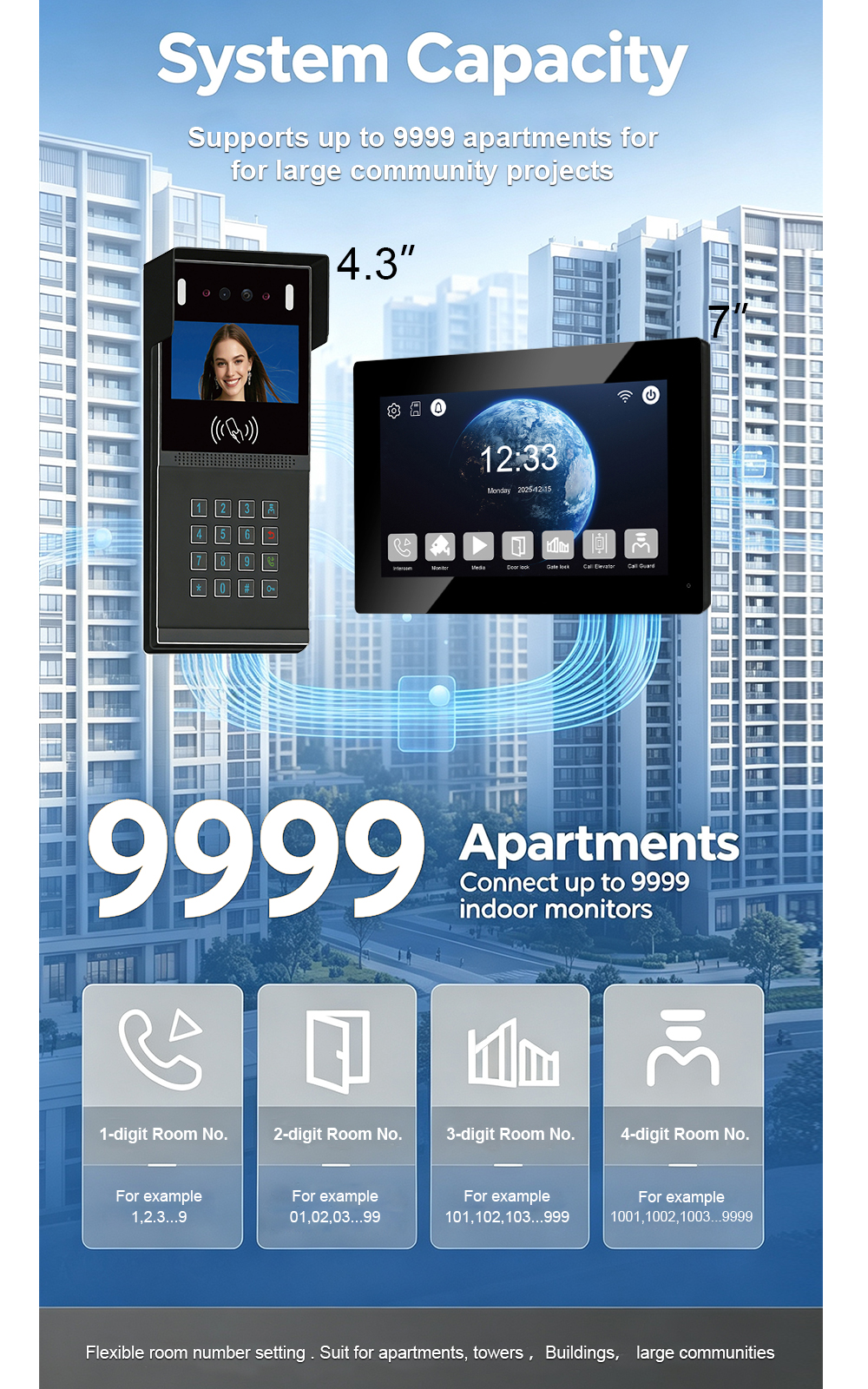
For buildings with hundreds of units, the smart layer includes room numbering, directory generation, call routing, and card lifecycle management—configured and documented so the system remains operable as staff and residents change.
Integration With Building Systems
Relay outputs and dry contacts allow the intercom to trigger lights, gate controllers, or building management systems; network events can feed alerts to property staff. The intercom stops being a standalone device and becomes part of the building’s infrastructure.
Safer Living: What Security Actually Means at the Door
“Safer” is easy to claim. In practice, it comes from a set of specific capabilities working together.
| Security function | How it is delivered |
|---|---|
| Visitor verification before entry | Clear camera image and display; night vision; wide field of view |
| Controlled access | Card, face, password, NFC, with permission scoping per user |
| Credential lifecycle discipline | Easy card addition and deletion; prompt removal when residents leave |
| Documented access | Access records and call history for review when needed |
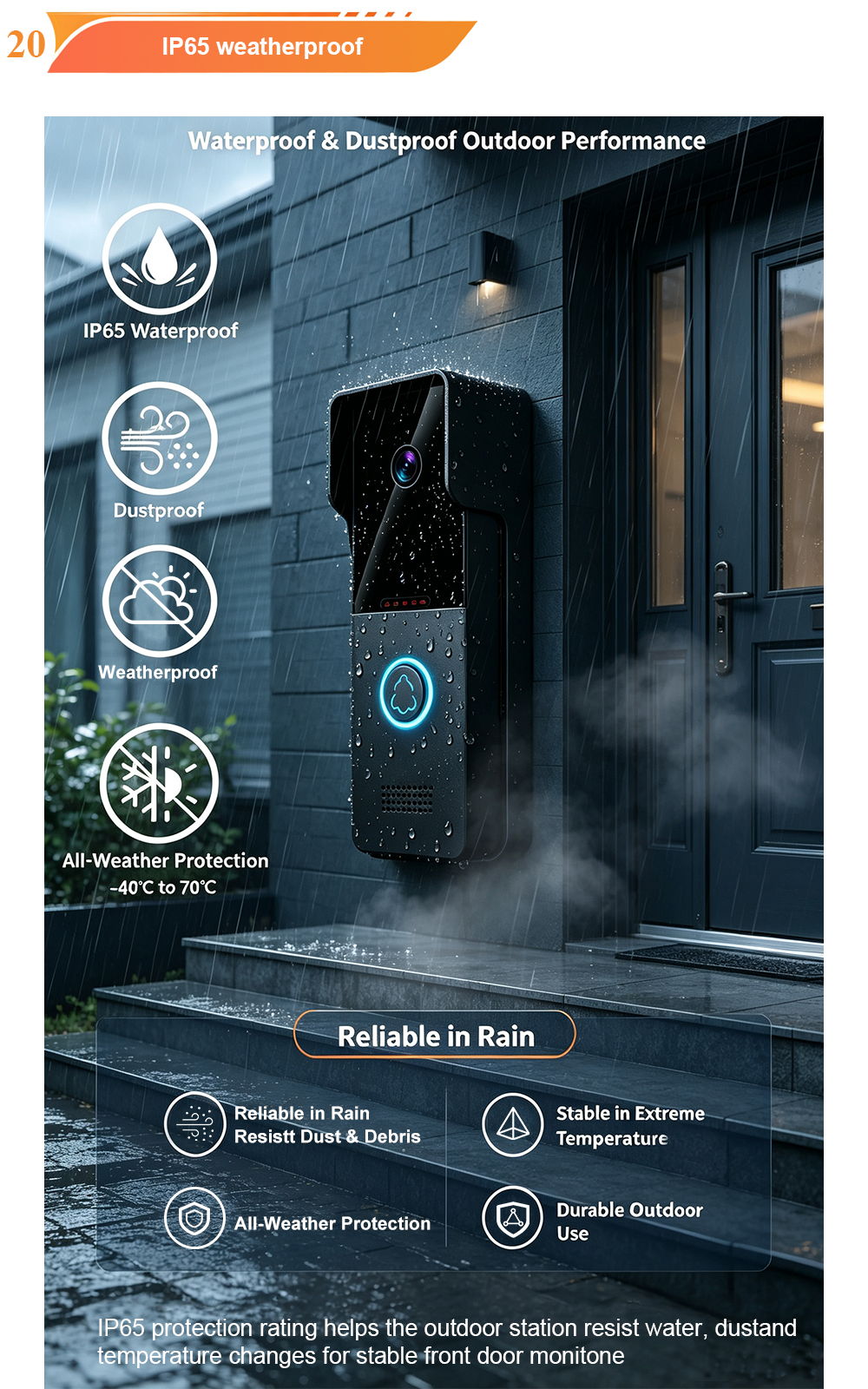
| Durabilidad en exteriores | IP65 water resistance, appropriate housing, correct cable entry |
| Surge and interference resilience | Grounding, EMC certification, appropriate installation practice |
| Reliable hardware | In-house component production and 24-hour aging test before shipment |
| Support after installation | Dedicated technical support for programming, installation, and wiring |
None of these is dramatic on its own. Together, they are the difference between an entrance that residents trust and one they tolerate.
Where a Smart Video Intercom Fits
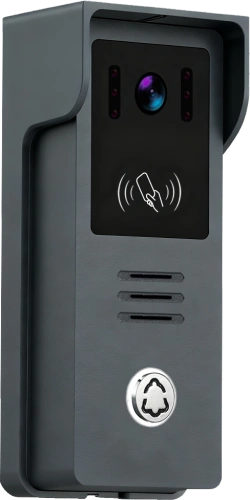
Villas and houses — a single household, often with multiple entry points, where aesthetics, durability, and flexible access all matter. A 7″ or 10″ indoor monitor paired with a metal-cased outdoor unit with card access and one-touch call covers the core requirement.
Edificios de apartamentos — many households sharing entrances, where the design challenges are scale and administration: room numbering, directory generation, card management, and face enrollment. An 8″ outdoor station with room list display, face recognition, and card unlock serves the shared entrance, while 7″ and 10″ monitors serve each apartment.
Multi-building communities — where address coding, directory scoping, and a guard station with USB camera support coordinate the entrance, the management desk, and the apartments.
Commercial and mixed-use buildings — where staff, tenants, and visitors require different access paths and the entrance must serve both resident and business traffic.
What to Verify When Specifying
A smart video intercom is a system, not a feature list. The questions that matter:
- Camera performance at night and in backlight — tested at the actual entrance, not in a showroom
- Audio quality at conversational volume — echo, hiss, and drop-out checked under real conditions
- Access method coverage — card, face, password, NFC, and room list call, with permission scoping
- Card and face management workflows — how easily credentials are issued and removed
- Network behavior — latency, jitter, QoS, and VLAN segmentation for IP systems
- Durabilidad en exteriores — IP65 rating, housing material, cable entry design, and installation practice
- Certification documentation — CE, FCC, RoHS, IP65, and EMC records matched to the exact SKU
- Support after delivery — a named technical support channel for programming and installation
Backed by FARHD’s Manufacturing Foundation
FARHD was founded in 1998 and has spent 28 years focused on video door phones and intercom systems. As a professional source factory, the company specializes in full in-house R&D and production—from TFT LCD screens, driver boards, and camera modules to complete villa and apartment building intercom systems.
The product line covers IP intercom systems for villas and apartments, 2-wire IP systems, 4-wire CVBS and AHD systems, analog apartment systems, wireless video doorbells, audio intercom systems, and various kits. Products hold international certifications including CE, FCC, RoHS, IP65 water resistance, and EMC, and every unit undergoes a 24-hour aging test before shipment.
Supported by 28 direct sales branches across China, FARHD has completed over 10,000 large-scale building video intercom projects, including ultra-large communities with 1,000, 3,000, and even over 5,000 households. OEM and ODM services cover customized software and hardware development, UI design, functional module adjustments, and tailored packaging, while SKD solutions are available for assembly factories across Europe, the Middle East, South America, Southeast Asia, the United States, Russia, India, Iran, Turkey, South Korea, and Italy.
A hassle-free after-sales service system ensures that upon product delivery, a dedicated technical support group is established to assist with programming, device installation, and wiring connections throughout the process.
See. Talk. Unlock. Every Time.
A smarter and safer living experience is not built from a long feature list. It is built from three actions that work reliably: a camera that sees clearly in every condition, audio that makes conversation natural, and access methods that let the right people in without friction—supported by the management functions that keep it accurate over years.
Whether you are specifying a system for a villa development, an apartment building, or a multi-building community, we welcome the conversation about which configuration fits your project.
We look forward to building a strong partnership with you and jointly shaping the future of smart living.
📩 Email: [email protected]
🌐 Website: www.farhd.com
📱 WhatsApp: +86 188 2370 9809 / +86 199 2545 1918
También le puede interesar
-
Rigorous Aging Test for FARHD Villa Video Intercom Outdoor Stations: Continuous Burn-In Before Every Shipment
A villa outdoor station has one job that cannot be compromised: it must work when someone is standing at the gate. Not when the showroom lights are on, not when the unit is fresh out of the box on day one—but on the hundredth day, in the rain, at night, when a resident is expecting…
-
FARHD Video Intercom Performance Test: 100m Ethernet Distance, Crystal Clear Video, and -45°C Extreme Temperature Reliability
Performance claims are easy to make and harder to prove. A datasheet can state that a system supports long cable runs. It can list an operating temperature range. It can describe audio and video quality in general terms. What it cannot do is show what happens when a 100-meter Ethernet cable carries a call between…
-
Every Detail Matters for Reliable Intercom Systems: Inside FARHD’s Production Discipline
Reliability in a video intercom system is rarely decided by a single dramatic feature. It is decided by a long series of small decisions—how a solder joint is formed, whether a gasket sits correctly, whether a unit was tested for a full day before it was packed, whether the documentation that accompanies a shipment matches…
-
FARHD 7″ Villa Kit Video Door Phone: A Complete, Installation-Friendly Entry System for Villa Projects
A villa intercom project has a distinct set of requirements that a standard apartment system does not address. There is no shared lobby, no room list, and no property manager coordinating hundreds of units. Instead, there is a single household, often with several entry points—a main gate, a garden door, a garage—and an expectation that…